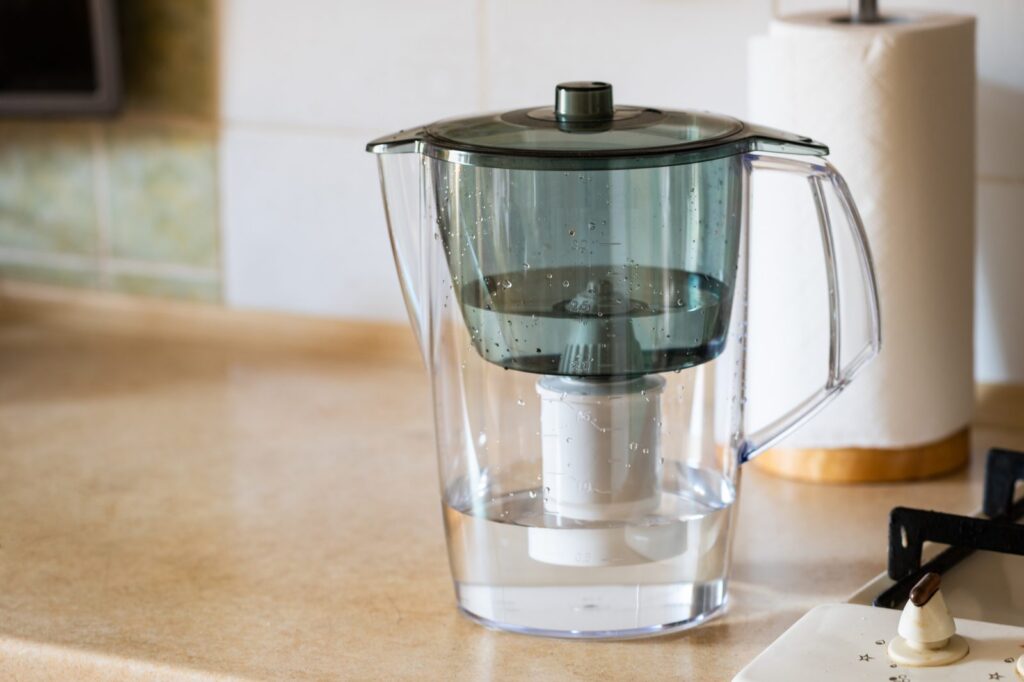
A water filter pitcher in the fridge is one of the most common kitchen items on O‘ahu. But many Ewa Beach families assume that pitcher removes “everything,” and that’s rarely true. What a filter actually does depends on its technology and on what it has been independently certified to reduce. Here’s how to tell whether your pitcher is doing the job you need, and when it’s worth looking at something more.
Key Takeaways
- Most pitcher filters use activated carbon. According to the CDC, their main purpose is to improve taste and smell rather than safety, and most aren’t designed to remove germs.
- Certification matters more than marketing. NSF/ANSI 42 covers taste and odor (aesthetic) claims, NSF/ANSI 53 covers health-related contaminants such as lead, and NSF/ANSI 58 covers reverse osmosis systems.
- A certification only applies to the specific contaminants listed on the label. No filter removes everything.
- Honolulu’s Board of Water Supply says its tap water meets all federal and state standards, so for many homes a filter is about taste, convenience or extra peace of mind.
- Pitcher cartridges typically need replacing every 2 to 6 months. An overdue cartridge won’t perform the way it was tested.
Start With What’s in O‘ahu Tap Water
Before choosing any filter, it helps to know what you’re filtering. The Honolulu Board of Water Supply (BWS) reports that its water meets all federal and state drinking water requirements, and it states that municipal water doesn’t require treatment by a home filtration unit. A few things about our water are still worth knowing:
- Chlorine: BWS adds only what’s needed to control bacteria, with levels of about 0.25 to 0.5 parts per million across the system.
- Hardness: Source water hardness on O‘ahu ranges from about 25 to 300 ppm depending on which wells are serving your area. Harder water leaves spots and scale.
- Fluoride: BWS does not add fluoride to its water.
- Trace contaminants: BWS has reported very low-level PFAS detections at some wells in recent years, which we covered in our guide to PFAS in O‘ahu drinking water.
Your building matters too. Lead usually comes from lead service lines, older pipes, solder and fixtures, not from the water source. That’s why the EPA focuses on certified point-of-use filters for lead, and why our post on lead in drinking water on O‘ahu is worth a read if you live in an older home.
What a Typical Pitcher Filter Does Well
Most pitchers rely on activated carbon, sometimes combined with an ion-exchange resin. Carbon is very good at grabbing chlorine and the compounds that cause off tastes and odors. Some cartridges also carry certification for lead or other specific contaminants, but two pitchers that look alike on the shelf can carry very different claims.
What Basic Filters Often Miss
The CDC is direct about the limits of pitcher and refrigerator filters. Here are the gaps that come up most often:
- Germs: The CDC notes that most home filters, including pitcher and fridge filters, aren’t designed to remove bacteria, viruses or parasites. Removing those takes very fine filtration (an absolute pore size of 1 micron or smaller for parasites, 0.3 micron or smaller for bacteria) or reverse osmosis.
- Dissolved minerals and salts: Carbon isn’t built to remove dissolved minerals like calcium and magnesium, so a pitcher won’t do much for hardness. The CDC lists reverse osmosis as the technology that removes substances like chloride and sodium and can reduce nitrate, fluoride and sulfate.
- Performance after the cartridge is spent: Filters are tested for a rated capacity. Once you pass it, results can drop off, and you usually can’t taste the difference.
One more caution from the CDC: don’t rely on taste or smell to judge water safety. Many harmful germs and chemicals don’t change how water looks, tastes or smells.
NSF/ANSI 42 vs. 53 vs. 58: Reading the Label
There are no federal regulations for home water filters, so independent certification is the best way to compare them. NSF International, along with other accredited certifiers, tests products against these voluntary American National Standards:
- NSF/ANSI 42 (aesthetic effects): Non-health contaminants such as chlorine, taste and odor, and particulates. Many pitchers carry this one.
- NSF/ANSI 53 (health effects): Specific health-related contaminants, with more than 50 possible claims such as lead, cysts like Cryptosporidium, and certain volatile organic compounds (VOCs).
- NSF/ANSI 401 (emerging compounds): Up to 15 trace contaminants, such as certain prescription drugs, over-the-counter medications and pesticides.
- NSF/ANSI 58 (reverse osmosis): Systems that push water through a semi-permeable membrane, the technology the CDC lists for the broadest range of dissolved contaminants.
For lead, the EPA recommends checking for two things on the package: NSF/ANSI 53 certification for lead reduction and NSF/ANSI 42 certification for particulate reduction (Class I), since lead can be dissolved or attached to tiny particles. Look for the certification mark and the exact contaminant list, not just “NSF” somewhere on the box. NSF itself notes that certification doesn’t mean a filter reduces every possible contaminant.
When It Makes Sense to Step Up From a Pitcher
A pitcher is a fine choice if your main goal is better-tasting water and your cartridge is certified for what you care about. Many Ewa Beach and Kapolei families eventually want more, though, usually for one of these reasons:
- You live in an older home and want lead protection at the tap you drink from.
- You want lower dissolved solids, not just less chlorine.
- You’re tired of refilling a pitcher several times a day for a big household.
That’s where an under-sink reverse osmosis system comes in. The Pono Revival Alkaline Under Counter System combines carbon stages and a reverse osmosis membrane with mineral stages that add minerals back after filtration. It has its own dedicated faucet and storage tank, plus a TDS meter so you can watch water quality and know when filters are due. If you already have a system, you can find cartridges in our water filters and replacement filters section.
Not ready to install anything? Water refills at our Ewa Beach showroom are another option, and we offer free same-day water delivery for Ho‘opili, Ewa Beach and Kapolei residents.
Simple Habits for Any Filter
- Replace on schedule. The EPA lists a typical pitcher cartridge life of 2 to 6 months, depending on the model, how much you use it and your water quality. Write the date on the pitcher.
- Keep it cold and clean. Store filtered water in the fridge and wash the pitcher regularly. Once chlorine is removed, germs have less to hold them back.
- Follow the instructions. The CDC recommends changing filters on the manufacturer’s schedule and wearing gloves while you do it. People with weakened immune systems should ask their healthcare provider about filter changes.
Frequently Asked Questions
Do pitcher filters remove lead?
Some do and some don’t. Check the package for NSF/ANSI 53 certification that specifically lists lead, plus NSF/ANSI 42 Class I particulate reduction, as the EPA recommends. If lead isn’t on the list, don’t assume the filter reduces it.
Do I need a water filter on O‘ahu?
Not necessarily. The Board of Water Supply says its water meets all federal and state standards. Many families filter for taste, for older household plumbing, or for extra peace of mind about trace contaminants.
Will a pitcher filter soften hard water?
Not much. Carbon filters are designed for chlorine, taste and odor, not for the calcium and magnesium that make water hard. Reverse osmosis or a water softener is the usual answer for hardness.
How often should I change a pitcher filter?
Follow the manufacturer’s rated gallons or months. The EPA puts typical pitcher cartridges at 2 to 6 months. Replace sooner if flow slows or the taste changes.
Talk Story With Us About Your Water
Not sure whether your pitcher is enough? Stop by our showroom at 91-3575 Kauluakoko St, Unit 1105, in Ewa Beach. We’re happy to talk through options that fit your home and budget. You can also call us at (808) 466-3590, send us a message, or set up water delivery.
This article is for general information only and isn’t medical advice. Filter performance varies by product; check each product’s certification for the specific contaminants it reduces. Information current as of November 2026.